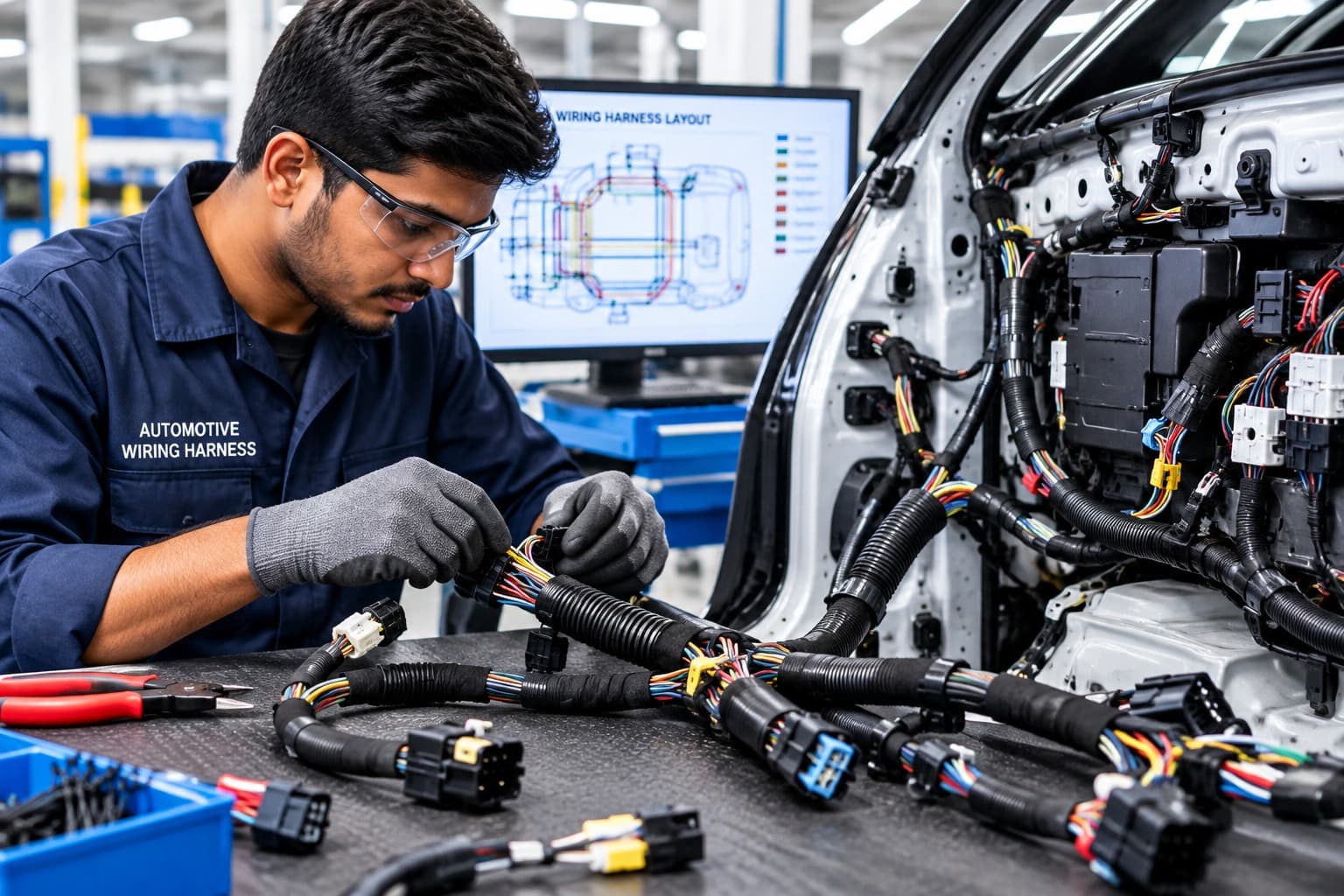
Nustech Academy features a practical Wiring Harness Design Engineer Course in Pune, enabling students to strengthen their design skills and industry knowledge. Our course is designed to help aspiring and working engineers develop practical expertise in vehicle wiring systems, automotive harness development, electrical architecture, and industry-oriented design processes. We combine engineering fundamentals with hands-on learning to help learners understand how wiring harnesses are planned, designed, documented, and prepared for real-world automotive applications.
Whether you are a graduate seeking your first technical opportunity or an experienced professional looking to strengthen your automotive design skills, we provide a structured learning pathway focused on developing industry-relevant knowledge and practical capabilities for a successful career in automotive wiring harness design.
Contact us to learn about upcoming batches, course duration, fees, certification, and enrollment details. Start your journey toward a successful career in automotive wiring harness design and electrical engineering.
Effective training should go beyond explaining terminology and theoretical concepts. Our Wiring Harness Design Engineer Training emphasizes practical understanding so learners can recognize how harness engineering decisions affect vehicle performance, manufacturing, assembly, maintenance, and reliability.
The training introduces learners to important areas such as:
This approach allows candidates to develop a broader perspective instead of viewing wiring harnesses as isolated electrical components.
Our Wiring Harness Design Engineer Course in Pune provides practical, industry-focused knowledge of automotive wiring systems and harness development. Learn essential skills in design, electrical architecture, routing, packaging, documentation, components, and validation for a career in automotive engineering.
| Module | What You Will Learn |
|---|---|
| Automotive Wiring Harness Fundamentals | Learn the basic structure, functions, components, and terminology used in modern automotive wiring harness systems. Understand how harnesses connect different electrical systems and support reliable vehicle operation. |
| Vehicle Electrical System Fundamentals | Understand circuits, power distribution, grounding, electrical signals, connectors, and electrical loads used in vehicles. Learn how these electrical elements work together to operate various automotive functions effectively. |
| Wiring Harness Architecture and Design | Learn how electrical requirements are organized into practical harness structures for different vehicle systems. Understand circuit grouping, connectivity, distribution, and key principles involved in harness architecture. |
| Harness Routing, Packaging, and Integration | Understand how wiring harnesses are routed and positioned within limited vehicle spaces safely and efficiently. Learn to consider packaging, bend radius, protection, accessibility, interference, and installation requirements. |
| Automotive Connectors and Harness Components | Gain knowledge of wires, terminals, connectors, clips, grommets, sleeves, and protective components used in harness assemblies. Understand how the right components contribute to secure connections, durability, and reliable electrical performance. |
| Harness Engineering Drawings and Documentation | Learn how wiring information is represented through schematics, wiring diagrams, drawings, specifications, and technical documents. Develop an understanding of accurate documentation required for manufacturing, assembly, testing, and design communication. |
| Wiring Harness Design Validation and Quality | Learn how harness designs are reviewed for electrical continuity, connectivity, physical compatibility, and functional accuracy. Understand key validation considerations such as manufacturability, serviceability, routing quality, and design reliability. |
The program can be valuable for candidates from different engineering backgrounds who want to establish themselves in automotive electrical and harness design.
A successful harness engineer needs more than software familiarity; the role requires an understanding of electrical systems, vehicle packaging, engineering standards, and design practices.
The Wiring Harness Design Engineer Skills Course helps develop capabilities such as:
The Automotive Wiring Harness Design Engineer Course provides a focused understanding of harness applications used across modern vehicles. Learners can explore electrical distribution and wiring requirements associated with body systems, powertrain functions, interiors, lighting, safety systems, infotainment, and other vehicle domains.
Related areas may include:
Choose a career-focused learning experience designed to help you build practical automotive harness expertise, strengthen your technical profile, and prepare for real-world engineering opportunities.
Nustech Academy offers a specialized Wiring Harness Design Engineer Course in Pune. Our course helps learners develop practical knowledge of vehicle wiring systems, harness architecture, routing, packaging, component integration, documentation, and design validation.
Turn your engineering knowledge into specialized automotive expertise with our Wiring Harness Design Engineer Course. Gain practical skills, earn industry-focused certification, and prepare for exciting opportunities in automotive wiring harness and electrical design.
Enroll Today and Start Your Journey Toward a Successful Wiring Harness Engineering Career!
Get Course Details | Talk to Our Experts | Enroll Now
Yes, practical learning can include design exercises, project-based assignments, and real-world automotive harness applications. This approach helps learners connect theoretical concepts with actual wiring harness development processes.
Depending on the training program, learners may work with tools such as Siemens NX, CATIA Electrical, Capital Harness XC, Creo, or AutoCAD Electrical. Software exposure helps candidates understand digital harness routing, design, documentation, and engineering workflows.
Candidates can explore opportunities in automotive OEMs, Tier-1 suppliers, EV companies, engineering service providers, and related industries. Common career options include harness design, electrical design, CAD, routing, integration, and validation positions.
Prior industry experience is generally not essential for beginner-level training programs. Candidates can start with fundamental concepts and progressively develop the technical knowledge required for harness design work.